Modes of Vision between Subject and Form: Investigating Twofoldness in Painting Perception
Published in Journal of Eye Movement Research, 2010
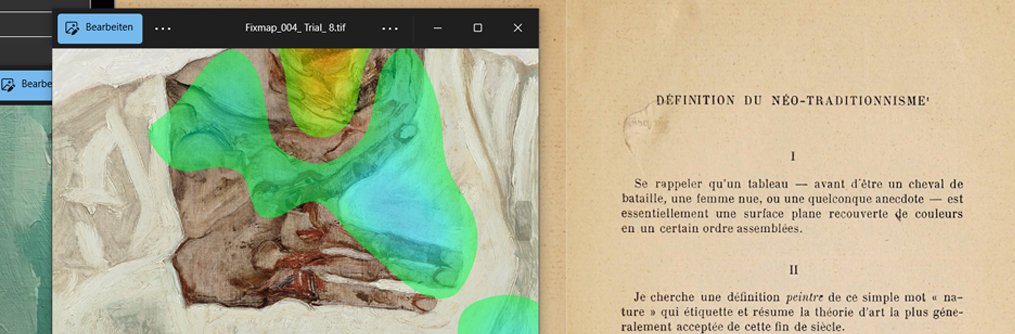
Recommended citation: Miscenà, A., Arato, J., & Rosenberg, R. (2020). Absorbing the gaze, scattering looks: Klimt’s distinctive style and its two-fold effect on the eye. Journal of Eye Movement Research, 13(2).
Download Paper
Published in Journal of Eye Movement Research, 2020
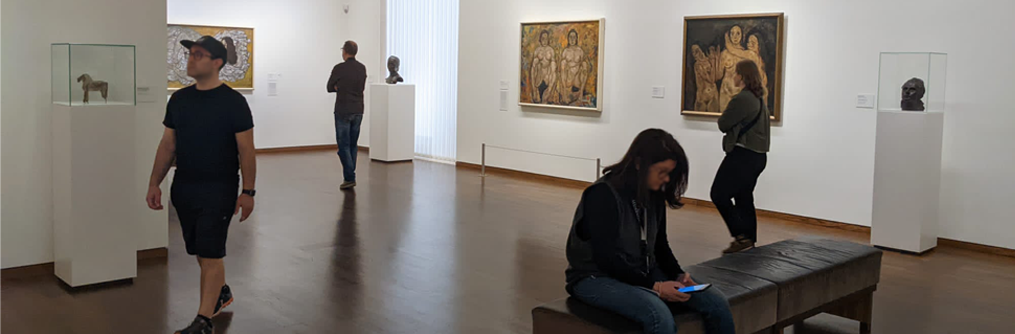
Recommended citation: Reitstätter, L., Brinkmann, H., Santini, T., Specker, E., Dare, Z., Bakondi, F., Miscenà, A., Kasneci, E., Leder, H., & Rosenberg, R. (2020). The display makes a difference: A mobile eye tracking study on the perception of art before and after a museum’s rearrangement. Journal of Eye Movement Research, 13(2).
Download Paper
Published in Art and Perception, 2023
Recommended citation: Fontoura, P., Miscenà, A., Menu, M., & Schaeffer, J. (2023). Painting Restoration and the Eye of the Beholder. Art & Perception, 11(3-4), 270-294.
Download Paper
Published in Feminist Media Studies, 2024
Recommended citation: Miscenà, A., Frentzen, V., Arato, J., Dare, Z., Leder, H., & Rosenberg, R. (2024). No such thing as the female eye: ditching gender-binary categories in art perception. Feminist Media Studies, 1–25.
Download Paper
Published in Proceedings of the ACM on Computer Graphics and Interactive Techniques, Volume 9, Issue 2, 2026
Recommended citation: Long, X., Arato, J., Kury, S., Miscenà, A., & Rosenberg, R. (2026). HeatMatch: Orientation-aware visualization and comparison of very dense saccade patterns. Proceedings of the ACM on Computer Graphics and Interactive Techniques, 9(2),18.
Download Paper
Published:
Published:
Academic Excursion (deu), University of Vienna, 2022
This excursion takes students to Florence to explore the city’s extraordinary artistic and cultural heritage through a hands-on approach. Visits to major sites will provide students with the opportunity to engage directly with the works and spaces that shaped the Renaissance.
Undergraduate Semester Course (deu), University of Vienna, 2023
The aim of this course is to dissect the journal “Ver Sacrum”, an early project of the Viennese Secession. Through visual and historical analysis of published issues (1989-1903), we will explore the anatomy of a modern magazine: its creation, editorial history, readership, and its (premature) death. The course can be interpreted as a case study in the larger context of modern journals, providing a window onto print culture at the turn of the century and the innovative function it played for artists and readers alike. — Contact hours: 22.5 (90’/week, 15 weeks)
Undergraduate/Postgraduate Semester Course (eng/deu), University of Vienna, 2023
Museum visitor, collector, curator; the work of the art historian can address a variety of audiences, each presenting a set of specific challenges. The goal of this course is to develop advanced writing and editing skills useful not only in academic contexts, but also in a range of professional situations in the art world. The class is conceived as a series of participatory workshops with different scenarios: curating an exhibition, conducting provenance research, drafting condition reports, editing an auction catalogue and more. Through analysis of existing text typologies as well as targeted exercises, students will be taught to produce informative and structured contributions for each of these situations. The course material will serve as a toolbox for them to refer to - during and after their studies. — Contact hours: 22.5 (90’/week, 15 weeks)
2 Undergraduate Semester Courses (eng), 1 Short Course (eng), CIEE, Rome, 2026
In this class we will examine the networks of artists, architects, intellectuals, and patrons who shaped the cultural life of Rome between the 15th and 16th century, with particular attention to the figure of Michelangelo. Emphasis will be placed on two sides of “Rinascimento”: one technical, the other theoretical. We will explore how patronage, work organization and technical knowledge transformed the arts, while considering the revival of classical values and their philosophical implications for artists’ vocabularies, ambitions, and for the emerging concept of the artist-genius. — Contact Hours: 45 hours (Semester: 3h/week, 15 weeks. Short course: 7.5h/week, 6 weeks)
Postgraduate Semester Course (eng), Kunstuniversität Linz, 2026
Visual attention is one of the central currencies of the visual arts. With the rise of industrial modernity and mass culture, attracting, directing, and sustaining attention became increasingly central to artistic practice already at the beginning of the 20th century. This course examines the development of modern and contemporary art through the lens of the attention economy and attentional capitalism. It considers how practices of making, exhibiting, and selling art have sought to shape and at times manipulate the viewer’s attention; including how changing conditions of display and consumption have transformed the relationship between artworks and their audiences. — Contact Hours: 22 hours (Semester: 1.5h/week, 15 weeks)
Postgraduate Semester Course (deu), Kunstuniversität Linz, 2026
The course examines the transformation of pictorial space in the 15th century – from the spatial conventions of medieval painting to the increasingly systematic construction of three-dimensional spaces in the Renaissance. In doing so, it challenges the notion of linear progress towards a superior form of representation. Rather than viewing linear perspective as a natural or necessary ‘evolution’ in the history of art, we regard it as a historically specific way of organising vision. Central to this is the question of how perspective transformed the understanding of art, artistic practice, the status of painting and the visual culture of early modern Europe. (Semester: 1.5h/week, 15 weeks)